
Key Takeaways
- Yellow star-thistle is an aggressive invasive weed with distinctive yellow flowers and sharp spines that can spread rapidly across landscapes, outcompeting native vegetation.
- This Mediterranean native is extremely toxic to horses, causing “chewing disease,” and can also harm other livestock, dogs, and cats if consumed.
- Effective control methods include manual removal before seed production, targeted herbicide applications, and establishing competitive native vegetation.
- Unlike beneficial milk thistle, which has medicinal properties, yellow star-thistle provides minimal ecological value while causing significant environmental and economic damage.
- Early identification and prompt management are crucial, as a single yellow star-thistle plant can produce up to 100,000 seeds with viability lasting 3-5 years in soil.
Yellow star-thistle has become the nightmare of gardeners, farmers, and land managers across America. This aggressive invader transforms beautiful landscapes into prickly, impenetrable fields while threatening both native ecosystems and agricultural productivity. The Plant Conservation Alliance’s Alien Plant Working Group has identified it as one of the most destructive invasive species in the western United States.
What Is Yellow Star-Thistle and How to Identify It
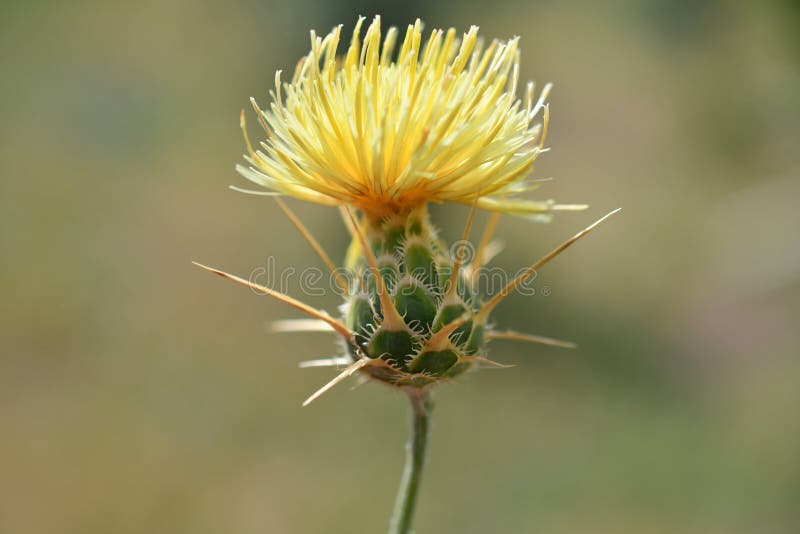
Yellow star-thistle (Centaurea solstitialis), also known as Barnaby’s thistle, is an annual herbaceous plant that belongs to the Asteraceae family. This deceptively attractive weed can grow between 1-3 feet tall and is most recognizable during its flowering stage from late spring through summer. Don’t be fooled by its sunny appearance – this plant is as problematic as it is distinctive.
Physical Characteristics and Growth Patterns
Identifying yellow star-thistle becomes easier once you know its key features. The plant begins as a basal rosette of deeply lobed leaves that hug the ground. As it matures, it develops a rigid, upright stem with winged branches covered in fine, whitish-gray hairs giving it a slightly woolly appearance. Its most distinctive features are the bright yellow flowers that sit atop stems surrounded by sharp, straw-colored spines measuring up to 1 inch long – these spines radiate outward like stars, giving the plant its common name.
The lifecycle of yellow star-thistle makes it particularly successful as an invader. It germinates with fall or winter rains, developing a deep taproot that can extend over 3 feet into the soil. This extensive root system allows it to access water unavailable to native plants with shallower roots, giving it a competitive advantage during dry periods. Each plant can produce up to 100,000 seeds with remarkable viability, and these seeds can remain dormant in the soil for 3-5 years, making long-term management challenging.
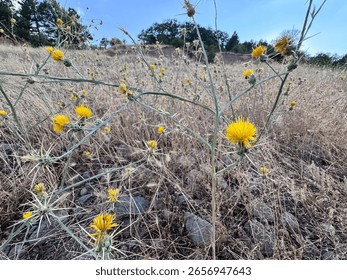
Looking at a field infested with yellow star-thistle reveals how dramatically it can transform a landscape. During summer, the plant’s golden blooms might appear attractive from a distance, but up close, the sharp spines create an impenetrable thicket that wildlife, livestock, and humans alike learn to avoid. Land management experts from Western Weed Control recommend identifying infestations early, as small patches are significantly easier to manage than full-blown invasions.
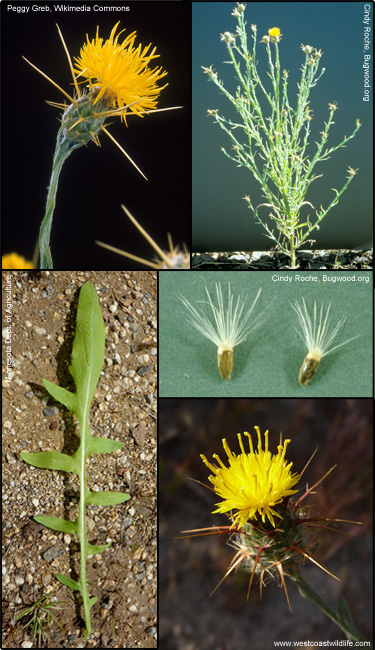
“Yellow starthistle (Centaurea solstitialis)” from learn.misin.msu.edu and used with no modifications.
Yellow Star-Thistle vs. Milk Thistle: Key Differences
Yellow star-thistle is often confused with milk thistle (Silybum marianum), but these plants have significant differences worth noting. Milk thistle, while also considered invasive in some regions, has distinctive white-marbled leaves with white veining patterns that yellow star-thistle lacks. Furthermore, milk thistle produces purple flowers rather than yellow, and its spines, though formidable, differ in arrangement from the star-pattern of its yellow cousin. If you are curious about other plants and their impact, you might be interested in learning about the American chestnut and its historical uses.
Unlike yellow star-thistle, milk thistle has recognized medicinal properties. For centuries, milk thistle extract has been used to treat liver conditions, and modern research continues to investigate its potential benefits. Yellow star-thistle, conversely, offers virtually no beneficial uses while causing significant environmental and economic damage. The National Invasive Species Information Center estimates that yellow star-thistle management and lost productivity cost the U.S. millions of dollars annually.
Other Common Thistles You Might Confuse It With
Several other thistle species might be mistaken for yellow star-thistle, particularly in their early growth stages. Bull thistle (Cirsium vulgare) and Canada thistle (Cirsium arvense) both share the prickly nature of yellow star-thistle but produce purple flowers rather than yellow. Scotch thistle (Onopordum acanthium) grows much larger than yellow star-thistle, often reaching heights of 8 feet or more, with distinctive grayish-blue foliage and purple flowers.
The key identifying feature that separates yellow star-thistle from these other common thistles is its distinctive yellow flowers combined with the star-shaped arrangement of spines surrounding each flower head. Additionally, yellow star-thistle lacks the broad, spiny leaves that characterize most other thistle species. Early identification is crucial, as different thistle species may require slightly different control approaches.
Native Origins and Current Spread
Mediterranean Roots: Where Yellow Star-Thistle Comes From
Yellow star-thistle is not native to North America but rather to the Mediterranean Basin, including parts of southern Europe, North Africa, and the Middle East. The plant evolved in these regions over thousands of years, developing adaptations perfectly suited to the Mediterranean climate with its wet winters and dry summers. In its native range, yellow star-thistle exists in balanced ecosystems with natural predators and competing vegetation that keep its population in check.
“5+ Hundred Yellow Star Thistle Royalty …” from www.shutterstock.com and used with no modifications.
Perfect Conditions for Growth and Reproduction
Yellow star-thistle thrives in environments with hot, dry summers and mild, wet winters—conditions similar to its Mediterranean homeland. This invasive plant particularly flourishes in disturbed soils, making roadsides, overgrazed pastures, abandoned fields, and construction sites prime targets for invasion. Its extraordinary reproductive capacity is perhaps its most formidable trait, with a single plant capable of producing up to 100,000 seeds that can remain viable in soil for 3-5 years.
The plant’s success comes from its impressive adaptability. Its deep taproot system, which can extend more than 3 feet into the soil, allows it to access water resources unavailable to native plants with shallower roots. This adaptation gives yellow star-thistle a significant competitive advantage during drought conditions. Furthermore, the plant’s spiny flower heads deter grazing animals, allowing it to complete its lifecycle while more palatable native plants are consumed, creating a feedback loop that further promotes its dominance. For those interested in plant safety and care tips, learn more about sword fern care.
Arkansas Invasion: Current Status and Concerns
In Arkansas, yellow star-thistle has established footholds in several counties, though it hasn’t reached the catastrophic levels seen in western states like California. The Arkansas Natural Heritage Commission has identified it as a significant concern, particularly in the northwestern regions of the state where conditions most closely resemble its preferred habitat. Monitoring efforts by the University of Arkansas Cooperative Extension Service have tracked its spread, finding that transportation corridors serve as primary vectors for its movement across the state.
Arkansas’s agricultural economy faces substantial risk from yellow star-thistle expansion. With livestock production representing a major sector of the state’s agricultural industry, the potential for forage reduction and animal poisoning creates considerable economic concerns. Conservation biologists working in the Natural State have emphasized the importance of early detection and rapid response programs to prevent the devastating infestations witnessed in other regions. For more information on how to manage these risks, you can explore safe garden ideas that might help mitigate the spread of invasive species.
U.S. Distribution Map: Where It’s Taking Over
The spread of yellow star-thistle across the United States tells a cautionary tale of invasive species management. First reported in California in the mid-1800s, likely arriving as a contaminant in alfalfa seed, it now infests over 15 million acres in California alone—approximately 15% of the state’s total land area. The plant has established populations in at least 41 states, with the heaviest concentrations in the western United States.
The pattern of spread follows human activity closely, with initial establishment along transportation routes, followed by expansion into adjacent natural areas. Climate modeling by the USDA suggests that much of the central and eastern United States contains suitable habitat for yellow star-thistle, indicating that without aggressive management, its range will likely continue to expand. Idaho, Oregon, and Washington have all seen dramatic increases in yellow star-thistle populations over the past several decades, demonstrating the plant’s capacity for rapid territorial conquest when left unchecked.
Why Yellow Star-Thistle Is a Major Problem
The golden flowers of yellow star-thistle might appear innocuous from a distance, but this invasive plant represents one of the most significant ecological threats in many regions. Its impact extends beyond mere nuisance status into serious environmental, agricultural, and economic damage. Understanding these impacts helps explain why aggressive management approaches are warranted and necessary.
Once established, yellow star-thistle creates a cascade of problems that compound over time. The plant alters soil chemistry, disrupts native pollinator relationships, reduces biodiversity, and creates hazardous conditions for humans and animals alike. According to the California Invasive Plant Council, no other invasive plant has had such widespread ecological impact in the western United States, making control efforts a priority for land managers across multiple states.
Ecological Damage to Native Habitats
Yellow star-thistle transforms ecosystems by outcompeting native vegetation for resources. Its aggressive growth habit and allelopathic properties—the release of biochemicals that inhibit the growth of neighboring plants—allow it to establish near-monocultures in previously diverse habitats. Native plant communities, which evolved over thousands of years to create balanced ecosystems, can be completely displaced within just a few seasons of yellow star-thistle invasion.
This displacement has far-reaching consequences for wildlife. Many native insects, birds, and mammals depend on specific native plants for food, shelter, and reproduction. When yellow star-thistle replaces these plants, wildlife populations suffer. Research from the University of California has documented significant reductions in pollinator diversity in heavily infested areas, as well as decreased populations of ground-nesting birds that require open grassland habitat. The plant’s dense growth pattern also impedes wildlife movement, fragmenting habitats and reducing their functionality for native species.
Agricultural Impact and Economic Losses
For agricultural producers, yellow star-thistle represents a substantial economic threat. When this invasive plant infiltrates rangeland and pastures, it can reduce forage production by up to 80%, directly impacting livestock carrying capacity and profitability. The sharp spines deter grazing, creating “dead zones” where valuable land becomes essentially unusable for livestock production.
Yellow Star-Thistle Economic Impact
Annual management costs in California: $20-25 million
Estimated forage loss in western states: $8-12 million annually
Reduction in land value of heavily infested properties: 30-80%
Water resource impact: Each plant consumes 15-25% more water than native vegetation
Beyond direct agricultural losses, yellow star-thistle creates significant management costs for public lands, recreational areas, and transportation corridors. The California Department of Food and Agriculture estimates that state and federal agencies spend over $20 million annually on yellow star-thistle control efforts. These costs are ultimately borne by taxpayers and consumers through increased food prices and reduced recreational opportunities. For more information on effective plant control methods, you might explore techniques like companion planting.
Water resource management is another area where yellow star-thistle creates economic problems. The plant’s extensive root system extracts more water from the soil profile than many native plants, potentially reducing water availability for streams, springs, and water tables. In arid western states where water resources are already strained, this additional pressure compounds existing management challenges and can contribute to drought conditions.
Toxic to Livestock: The “Chewing Disease” Connection
Perhaps the most dramatic impact of yellow star-thistle is its toxicity to horses. When horses consume the plant, particularly during its pre-flowering stages when spines haven’t yet developed, they can develop a neurological condition called nigropallidal encephalomalacia, commonly known as “chewing disease” or “yellow star-thistle poisoning.” This condition causes damage to the brain that affects motor control, particularly of the mouth and lips. Affected horses develop symptoms including inability to eat or drink, involuntary chewing movements, yawning, tongue flicking, and eventually, starvation if not provided supportive care. Most critically, this condition is irreversible once symptoms appear, and there is no effective treatment beyond supportive care.
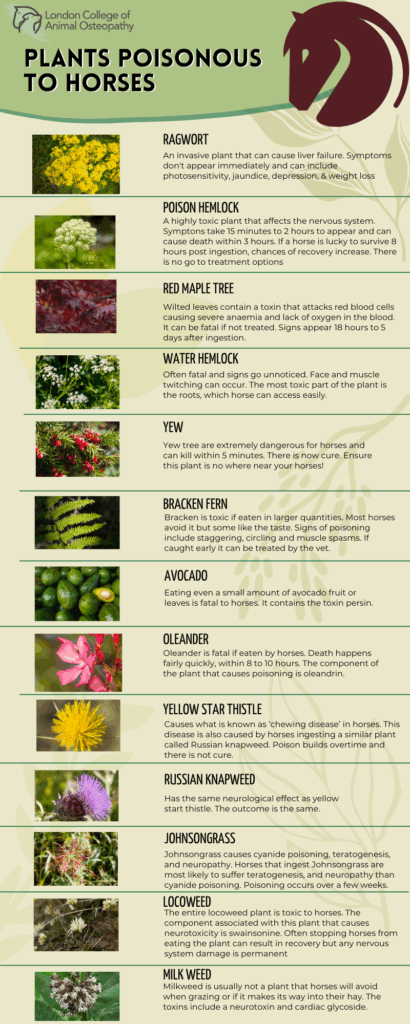
“Poisonous Plants for Horses – Part I” from www.animalosteopathycollege.com and used with no modifications.
Dangers to Horses, Dogs, and Cats
While horses are most severely affected by yellow star-thistle toxicity, other animals face different risks from this invasive plant. Cattle and sheep generally avoid consuming mature plants due to the spines, but may occasionally browse young rosettes, though they appear less susceptible to the neurotoxic effects than horses. However, the physical trauma from spines can cause oral injuries, leading to infection and reduced feeding in all livestock species.
Dogs and cats face risks primarily from physical injury rather than toxicity when encountering yellow star-thistle. The sharp spines can become embedded in paws, faces, and mouths, causing painful wounds that may become infected if not promptly treated. Pet owners in infested areas report frequent veterinary visits for spine removal, particularly in hunting dogs or outdoor cats that roam in areas where the plant grows. Additionally, dense patches of yellow star-thistle can harbor ticks and other parasites that may transfer to pets exploring these areas, creating secondary health concerns beyond direct injury from the plant itself. For more information on plant safety, check out this guide on wild buckwheat safety for pets.
5 Effective Ways to Control Yellow Star-Thistle
Controlling yellow star-thistle requires a strategic, integrated approach rather than relying on a single method. The most successful management programs combine multiple techniques tailored to the specific conditions of the infestation, the resources available, and the long-term goals for the affected area. These five control strategies represent the core approaches that land managers and property owners can employ to combat this persistent invader.
1. Manual Removal Techniques
For small infestations or environmentally sensitive areas where chemical use is inappropriate, manual removal offers an effective, albeit labor-intensive solution. Hand-pulling works best when the soil is moist and plants are still in the rosette or early bolting stage, before seed production begins. Always wear thick gloves to protect against spines, and pull from the base to remove as much of the taproot as possible. For larger patches, specialized tools like weed wrenches can improve efficiency. The key to success with manual removal is timing—yellow star-thistle must be removed before it produces seeds, typically beginning in late spring, and the area should be monitored regularly for new seedlings emerging from the existing seed bank.
2. Mowing and Cutting Strategies
Mowing can be an effective control measure when properly timed to the plant’s growth cycle. The optimal window for mowing occurs when the plant has reached 2-5% bloom but before seed production begins. At this stage, the plant has exhausted much of its energy reserves producing stems and flowers, and has minimal capacity to regrow. Mowing too early simply results in branching and more flower heads, while mowing too late risks spreading seeds. For best results, set mower height at 2-4 inches and monitor the area for regrowth, as multiple mowing sessions may be necessary within a single season to prevent seed production.
3. Chemical Control Options
Herbicides represent one of the most effective tools for managing larger yellow star-thistle infestations. Several selective herbicides can target this invasive weed while minimizing damage to desirable vegetation. Clopyralid, aminopyralid, and 2,4-D are commonly used options, with effectiveness varying depending on the growth stage of the plant and environmental conditions. Most experts recommend applying herbicides when plants are in the rosette to early bolting stage for maximum effectiveness.
When using chemical controls, always follow label instructions precisely and consider environmental factors. Herbicides should not be applied when rain is expected within 24 hours, during high winds, or near water sources. For land managers working to restore native habitats, selective herbicides applied at appropriate times can significantly reduce yellow star-thistle while allowing native grasses and forbs to recover. University extension offices can provide region-specific recommendations for the most effective herbicide options and application timing based on local conditions and regulations.
4. Biological Control Methods
Biological control utilizes natural enemies of yellow star-thistle to reduce its vigor and reproductive capacity. Since the 1980s, the USDA has approved several insects specifically targeting this weed, including seed-head weevils (Bangasternus orientalis, Eustenopus villosus) and seed-head flies (Urophora sirunaseva, Chaetorellia australis). These specialized insects feed on the developing flower heads, reducing seed production by 50-75% in established populations. While biological control agents won’t eradicate yellow star-thistle completely, they can significantly reduce its dominance when integrated with other management approaches.
The effectiveness of biological control varies by region and climate conditions. In California and other western states, these insects have established successfully and provide ongoing suppression of yellow star-thistle, particularly in remote areas where other control methods are impractical. Land managers interested in biological control should consult with their state’s department of agriculture or university extension service, as the release of biological control agents typically requires permits and professional guidance to ensure effectiveness and prevent unintended consequences.
5. Preventing Spread Through Good Practices
Prevention remains the most cost-effective approach to yellow star-thistle management. For property owners and land managers, implementing preventative measures can protect uninfested areas and prevent reinvasion of treated sites. Always clean equipment, vehicles, clothing, and pets after traveling through infested areas to prevent seed transport. When moving livestock, hold animals in weed-free areas for several days before transferring them to clean pastures to allow any consumed seeds to pass through their digestive systems.
Establishing competitive vegetation creates natural resistance to yellow star-thistle invasion. Native perennial grasses and forbs can effectively compete with yellow star-thistle seedlings for resources, particularly light and water. In agricultural settings, maintaining healthy pasture with appropriate grazing rotation prevents the soil disturbance and reduced plant competition that favor yellow star-thistle establishment. The California Native Grasslands Association recommends specific seed mixes designed to create resilient plant communities that resist invasion while providing valuable habitat and forage.
For gardeners and homeowners, early detection provides the opportunity for rapid response before small infestations become unmanageable. Learn to identify yellow star-thistle in its rosette stage, when control is easiest, and monitor property boundaries, driveways, and other potential points of introduction regularly. Report new sightings to local extension offices or invasive species hotlines to help track the spread of this destructive weed and potentially qualify for assistance with control efforts.
- Monitor clean areas regularly for early detection
- Clean equipment, vehicles, and clothing after visiting infested areas
- Establish competitive native vegetation in vulnerable areas
- Use weed-free hay and seed for restoration or agricultural activities
- Implement grazing management plans that prevent overgrazing
- Report new infestations to local agricultural extension offices
Long-Term Management: Restoring Land After Infestation
Successfully eliminating yellow star-thistle requires more than just removing the existing plants—it demands a comprehensive restoration strategy to prevent reinfestation. After initial control measures, the disturbed soil often contains thousands of yellow star-thistle seeds per square foot, creating perfect conditions for a new invasion cycle. Effective restoration transforms this vulnerability into resilience by establishing desirable vegetation that can outcompete any emerging yellow star-thistle seedlings.
Native Plant Alternatives
Replacing yellow star-thistle with appropriate native plants creates sustainable, resilient landscapes that resist reinvasion. Native perennial grasses like blue wildrye (Elymus glaucus), purple needlegrass (Stipa pulchra), and Idaho fescue (Festuca idahoensis) establish deep root systems that effectively compete with yellow star-thistle seedlings for water and nutrients. These grasses also provide valuable forage for livestock and wildlife while supporting native pollinators and other beneficial insects.
For landscape restoration, consider incorporating native wildflowers like California poppy (Eschscholzia californica), yarrow (Achillea millefolium), and lupines (Lupinus spp.) alongside grasses to create diverse plant communities. The Xerces Society recommends including at least three flowering species that bloom in each season to support year-round pollinator populations. Working with local native plant nurseries or extension offices helps identify the species best adapted to your specific soil conditions and climate, maximizing restoration success.
Monitoring and Follow-Up Care
Even the most thorough initial control efforts won’t eliminate all yellow star-thistle seeds from the soil. Regular monitoring and prompt treatment of new seedlings remain essential for at least 3-5 years after initial control—the period when most seeds in the soil will either germinate or lose viability. Schedule monthly inspections during the growing season, focusing on previously infested areas and potential entry points like roadsides, trails, and disturbed soil. Document your findings with photos and GPS coordinates to track progress and identify patterns that might indicate new seed sources.
Successful restoration requires nurturing newly established desirable vegetation through its vulnerable early stages. During the first two growing seasons, provide supplemental irrigation during dry periods if possible, and protect new plantings from excessive grazing or disturbance. Consider applying mulch around newly planted natives to suppress yellow star-thistle germination and conserve soil moisture. As native vegetation becomes established, it will increasingly provide natural resistance to reinvasion, gradually reducing the need for active management while creating valuable habitat and ecosystem services.
When to Call in Professional Help
While many yellow star-thistle infestations can be managed by property owners, certain situations warrant professional intervention. Consider consulting with professional vegetation managers or licensed herbicide applicators when dealing with large infestations (over one acre), environmentally sensitive areas like wetlands or riparian zones, steep terrain that makes manual control dangerous, or when multiple failed control attempts indicate complex management challenges. Professionals bring specialized equipment, access to restricted herbicides, and experience with integrated management strategies that can overcome stubborn infestations. Many states offer cost-sharing programs through soil and water conservation districts to help landowners address invasive species, potentially reducing the financial burden of professional treatment. Nature’s Way Land Management specializes in ecological restoration and offers comprehensive invasive species control services that can transform degraded landscapes into thriving native ecosystems.
Frequently Asked Questions
Managing yellow star-thistle raises many questions for landowners encountering this invasive plant. The following frequently asked questions address common concerns about identification, control methods, and safety considerations. While these answers provide general guidance, local extension offices can offer region-specific recommendations tailored to your particular situation.
Understanding the biology and behavior of yellow star-thistle helps inform effective management strategies. These questions explore aspects of the plant’s lifecycle, toxicity, and control challenges that often arise during management efforts. For complex situations, consider consulting with invasive species specialists who can develop customized approaches based on your specific conditions and goals.
Remember that successful yellow star-thistle management typically requires persistence and an integrated approach combining multiple control methods. No single technique will completely resolve an established infestation, but consistent application of appropriate strategies can gradually reduce populations and ultimately restore healthy, resilient landscapes.
How quickly does Yellow Star-Thistle spread once established?
Yellow star-thistle can spread with alarming speed under favorable conditions. A single plant produces up to 100,000 seeds, with about 95% falling within 2-3 feet of the parent plant, creating dense patches that expand outward at rates of 10-15 feet per year. However, long-distance dispersal occurs through various vectors including wind, animals, vehicles, and contaminated hay or equipment, allowing the plant to establish satellite populations miles from the original infestation. Research from the University of California documented expansion rates exceeding 7,000 acres annually during peak invasion periods in some counties.
The plant’s rapid colonization ability makes early detection and prompt response essential. Small patches of less than 100 plants can grow to cover several acres within 3-5 years if left unmanaged. This exponential growth pattern means that control costs increase dramatically with each year of delayed action. The California Invasive Plant Council estimates that controlling a one-acre infestation costs approximately 10-20 times less than waiting until that same infestation covers 10 acres—a transformation that can occur in as little as 2-3 years under ideal growing conditions. For those managing landscapes with pets, understanding terrain and plant management can be crucial in preventing such invasive spread.
What are the first symptoms in animals that have consumed Yellow Star-Thistle?
In horses, the first signs of yellow star-thistle poisoning typically appear after animals have consumed 50-200% of their body weight in the plant over 30-90 days. Initial symptoms include difficulty eating and drinking, involuntary chewing movements, excessive yawning, and tongue protrusion. As the condition progresses, affected horses may exhibit drooping lips, food dropping from the mouth, weight loss, and increasingly desperate attempts to drink despite inability to swallow normally. Unfortunately, these neurological effects are permanent once they appear, as the toxin causes irreversible damage to brain tissue. Horse owners should immediately consult a veterinarian if these symptoms appear, though supportive care remains the only treatment option.
Can Yellow Star-Thistle grow back after being pulled out?
Yellow star-thistle typically does not regrow from roots if properly pulled with the taproot intact. However, if the plant is merely cut above ground or if part of the taproot remains, it can regrow, especially when cut before the flowering stage. The greater challenge comes from the extensive seed bank that develops in infested soil, with seeds remaining viable for 3-5 years. This means that even perfect removal of all visible plants must be followed by vigilant monitoring and repeated treatment of new seedlings emerging from the seed bank for several consecutive years. Success requires depleting this reservoir of seeds through preventing new seed production while simultaneously encouraging competitive vegetation that can suppress seedling establishment.
Is Yellow Star-Thistle harmful to humans?
While yellow star-thistle doesn’t cause the severe neurotoxic effects in humans that it does in horses, it still poses physical hazards. The sharp spines can cause painful puncture wounds that may become infected if not properly cleaned. People working to remove the plant should always wear heavy gloves, long sleeves, and eye protection to prevent injuries. Some individuals also report skin irritation or contact dermatitis from handling the plant, particularly when sap contacts the skin. Additionally, yellow star-thistle pollen has been identified as an allergen that can contribute to seasonal allergies in sensitive individuals, causing typical hay fever symptoms during its summer flowering period.
Are there any beneficial uses for Yellow Star-Thistle?
Despite its predominantly negative impacts, yellow star-thistle does have limited beneficial aspects. Beekeepers sometimes value it as a nectar source that produces a light-colored, mild-flavored honey during late summer when other nectar sources may be scarce. The plant has also been investigated for potential biofuel applications and for phytoremediation of some contaminated soils due to its deep taproot system. However, these minor benefits are vastly outweighed by its destructive ecological and economic impacts, making control and eradication the priority in most contexts. Unlike its cousin milk thistle, which has documented medicinal properties, research has not identified significant medicinal applications for yellow star-thistle that would justify its cultivation or preservation.
Yellow Star-Thistle Management Timeline
Fall/Winter: Monitor for and remove rosettes
Early Spring: Apply pre-emergent herbicides if appropriate
Late Spring: Hand-pull or spot-treat bolting plants
Early Summer: Mow at 2-5% bloom stage
Late Summer: Monitor for regrowth and prevent seed production
Year-round: Implement practices to prevent spread
Successful yellow star-thistle management requires perseverance and a long-term commitment. The plant’s persistent seed bank and aggressive growth habit mean that a single year of control rarely resolves an infestation. However, with consistent application of appropriate techniques and careful restoration of competitive vegetation, even heavily infested areas can be reclaimed. The California Department of Food and Agriculture reports that integrated management programs consistently applied for 3-5 years can reduce yellow star-thistle populations by over 95%, allowing native and beneficial plants to reestablish.
For property owners dealing with yellow star-thistle, connecting with local resources can significantly improve management outcomes. County extension offices, conservation districts, and invasive species councils often provide technical assistance, equipment loans, and even cost-sharing programs to support control efforts. Nature’s Way Land Management offers specialized services for properties with extensive infestations, bringing expertise and equipment that can accelerate the restoration process and help landowners reclaim productive, healthy landscapes from this tenacious invader.